The Papacy Problem: What the Evidence Actually Warrants
The evidence for Petrine primacy is strong. The real question is whether the specific form that primacy took in the West went beyond what the evidence warrants. I think it did.

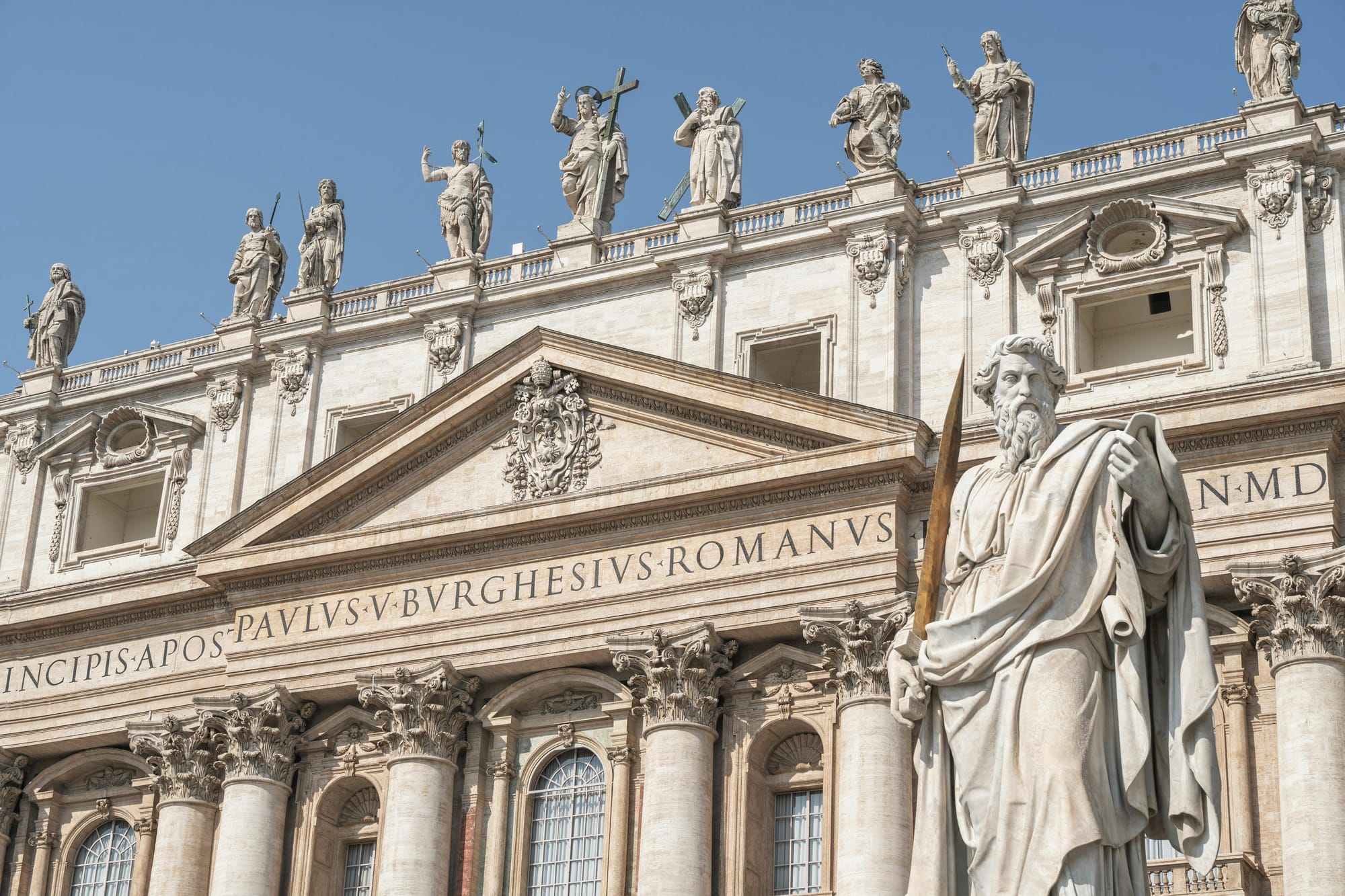
I've been sitting with a question that I think a lot of faithful Catholics avoid because it feels dangerous: if you take the strongest arguments for and against the papacy and lay them side by side, which case is actually more compelling?
Not which case do I want to be more compelling. Which case survives contact with the evidence.
I'm Catholic. I'm not writing this as someone looking for the exit. I'm writing it as someone who believes the Church is what she claims to be, and who thinks that belief is stronger, not weaker, when you're willing to stress-test it.
So let's stress-test it.
The Case For
The papacy's strongest scriptural foundation is Matthew 16:18-19: "You are Rock, and on this rock I will build my Church." Christ gives Peter the keys of the kingdom, and the language isn't accidental. It deliberately echoes Isaiah 22:20-22, where the key of the house of David is given to a prime minister who serves as a dynastic steward. That parallel matters enormously because it implies the office is successive, not a one-time personal commission that died with Peter. This isn't just Catholic eisegesis. The typological connection is textually grounded, and it gives you something the other Christian traditions struggle to provide: a principled answer to the question of who holds authority after the apostles are gone.
Luke 22:32 reinforces it: "I have prayed for you that your faith may not fail... strengthen your brethren." John 21:15-17 does it again: "Feed my sheep." Both single Peter out from the other apostles in a way that's hard to explain away as purely honorary.
Then there's the historical evidence, which is harder to dismiss than people on either side tend to acknowledge. Clement of Rome intervened in the affairs of the Corinthian church around 96 AD. Think about what that means: the Apostle John was likely still alive and much closer geographically, but it was Rome that stepped in. Ignatius of Antioch called Rome the church that "presides in love." Irenaeus, around 180 AD, pointed to Rome's apostolic succession as the standard by which to test whether a teaching was orthodox. The Council of Chalcedon in 451 acknowledged Rome's primacy, even if the East and West later fought bitterly over what that primacy meant in practice.
The overall trajectory shows a pattern where Rome's bishop functioned as a court of final appeal well before anyone sat down and formalized the theology of it. That's not nothing. That's centuries of lived practice pointing in a specific direction.
The Case Against
But the case against has serious force too, and pretending otherwise doesn't serve anyone.
The strongest argument is probably the ecclesiological one from the first millennium itself. The Eastern churches accepted Roman primacy of honor. They never understood it as the jurisdictional supremacy that developed in the medieval West. The operative framework for centuries was the pentarchy: five patriarchates (Rome, Constantinople, Alexandria, Antioch, Jerusalem) sharing governance. Constantinople, Alexandria, Antioch, and Jerusalem all understood themselves as possessing genuine apostolic authority of their own, not delegated power from Rome. When Rome defined papal infallibility at Vatican I in 1870, this was genuinely novel in the sense that no ecumenical council of the undivided Church had ever articulated anything like it.
The Protestant critique adds another layer. Paul publicly rebuked Peter in Galatians 2. That's hard to square with the idea that Peter held an office of supreme doctrinal authority. Acts 15 portrays the Jerusalem Council as a genuinely collegial deliberation where James, not Peter, delivers the decisive judgment. And both Reformed and Orthodox theologians point out that many Church Fathers interpreted the "rock" of Matthew 16 as Peter's confession of faith rather than Peter's person, making the passage about Christological truth rather than papal office.
There's also a historical-critical problem that I think Catholics need to take more seriously than we usually do. The papacy as it came to function by the high Middle Ages, with universal jurisdiction, the ability to depose kings, and claims to doctrinal infallibility, looks very different from anything you can extract from the New Testament or even the first few centuries. The argument that all of this was "implicit" from the beginning and simply "developed" over time requires Newman's theory of doctrinal development, and critics see that theory as unfalsifiable: it can justify any innovation after the fact by calling it development.
Where the Weight Falls
Here's where I land, and I want to be specific about why.
The strongest single argument for the papacy is the Isaiah 22 typological reading of the keys combined with the early historical evidence of Roman intervention. It gives you a coherent answer to a question every Christian tradition eventually has to face: when serious disputes arise, who decides? The papacy offers a concrete mechanism. Its critics tend to appeal either to conciliarism, which historically struggled to function without a convening authority, or to sola scriptura, which has produced thousands of competing interpretations with no principled way to adjudicate between them.
The strongest single argument against is the Orthodox one from the first millennium: if Christ truly established the papacy as Vatican I defined it, it's very difficult to explain why the entire Eastern half of Christendom, with its own unbroken apostolic succession, never understood it that way. That's not a theological argument from silence. It's a positive counterwitness from churches that were fully in communion with Rome for a thousand years and still rejected jurisdictional supremacy.
So the real question isn't whether Peter held a unique role. The evidence for Petrine primacy is strong. The real question is whether the specific form that primacy took in the West went beyond what the evidence warrants. And I think it did.
What Went Beyond the Evidence
The core claim with the weakest warrant is universal ordinary jurisdiction: the idea codified at Vatican I that the pope possesses immediate, full, and supreme authority over every diocese, every bishop, and every faithful Catholic on earth. Not just as a court of final appeal, but as a standing, active governing power.
Nothing in Scripture, the ante-Nicene fathers, or the conciliar practice of the first millennium supports that scope. What you actually see in the early centuries is Rome as a court of appeal when disputes couldn't be resolved locally, Rome as a guardian of orthodox teaching (particularly because of its dual apostolic foundation through Peter and Paul and its location in the imperial capital), and Rome as first among equals in honor and prestige, with a unique but not unlimited authority.
What you don't see is Rome appointing bishops in Antioch, overriding local synods at will, or claiming that the pope's ordinary jurisdiction extends into every local church as though the local bishop were a branch manager. That machinery developed gradually through the Gregorian Reform of the 11th century, the medieval papal monarchy, and then got dogmatized at Vatican I.
Papal infallibility is a related problem. The early Church resolved doctrinal disputes through ecumenical councils where the bishop of Rome had a privileged but not unilateral role. The idea that the pope can define doctrine ex cathedra, independently of a council and irreformably, has no analogue in the first millennium. Even Leo the Great's Tome at Chalcedon was submitted to conciliar examination. The bishops said "Peter has spoken through Leo," but they still debated and voted on it. They didn't treat it as automatically settled because Rome had spoken.
What a Papacy Aligned with the Evidence Would Look Like
Honestly? It would look a lot like what the Orthodox have always said they'd accept. A genuine primacy, not just a ceremonial title.
The Bishop of Rome would function as the convener and president of ecumenical councils, with real agenda-setting authority. He would serve as the final court of appeal in disputed matters, meaning you could appeal to Rome when local or regional processes failed, and that judgment would carry decisive weight. He would be the visible sign of universal communion, the bishop whose communion you need to be "in" to be recognizably part of the Catholic Church. And he would have a genuine teaching authority that carries a presumption of correctness, but one exercised within and accountable to the broader college of bishops and the received Tradition, not above it.
What he would not have is the power to unilaterally define dogma, override or suppress local liturgical traditions, appoint every bishop on earth, or govern as though the universal Church were a single diocese with the pope as its sole bishop. The subsidiarity principle that Catholic social teaching applies to civil governance would actually apply to the Church's own governance.
This is, interestingly, close to what some serious Catholic theologians have explored.
Ratzinger himself, before becoming Benedict XVI, wrote that Rome cannot require of the East anything more than what was held in common during the first millennium.
That's a remarkable admission from someone who later held the office.
The Protestant alternative of no visible structural authority has a thousand-year track record of producing fragmentation with no mechanism for resolution. When Lutherans disagree with Calvinists who disagree with Baptists who disagree with Anglicans, there is no table to come to. Sola scriptura doesn't solve the problem because the disagreement is precisely about what Scripture means, and there's no authorized interpreter to settle it. You end up with thousands of denominations, which is not what "that they may all be one" looks like.
But the maximalist papal claims of Vatican I also overreach. They solve the unity problem by concentrating so much authority in one office that it creates a different set of pathologies: theological innovation by fiat, suppression of legitimate diversity, and a governance structure that has no effective checks when the officeholder makes serious errors of judgment.
The first-millennium model threads the needle. You get a real, functioning center of unity with genuine authority. You get conciliar governance that acts as a check on any single bishop, including Rome. You get doctrinal stability rooted in consensus rather than unilateral declaration. And you get the flexibility for legitimate local diversity in liturgy, discipline, and theological expression.
The reason I find this most compelling isn't just theological. It's practical. This is the model that actually held the Church together for its longest continuous period of relative unity. The maximalist papacy presided over the Great Schism, the Avignon captivity, the Western Schism (three simultaneous popes), and the Reformation. The first-millennium model isn't utopian, but its track record is better, and its theological foundations are more defensible from both Scripture and Tradition.
The Trap Door
Now here's where it gets personally uncomfortable, because I'm Catholic, and I believe the Church is guided by the Holy Spirit, and what I've just laid out creates a real problem.
If you accept that Vatican I was a legitimate ecumenical council guided by the Holy Spirit, and that its definitions on papal infallibility and universal jurisdiction are irreformable dogma, then you can't just walk them back without undermining the very authority structure that produced them. It's self-referential.
The doctrine of infallibility was itself defined infallibly, so questioning it means questioning the mechanism by which you'd evaluate any doctrine. Pull that thread and the whole epistemological framework starts to unravel.
For a faithful Catholic, this feels dangerously close to saying the Holy Spirit dropped the ball at a council. And to say that something happened in the Church that wasn't guided by the Holy Spirit, when we assume it was, feels practically like blasphemy.
But I think there's more room here than it feels like at first.
The Holy Spirit and Councils Don't Work the Way Most Catholics Assume They Do
The Church has never taught that every word of every conciliar document is directly dictated by the Holy Spirit. The guidance of the Spirit is understood as a negative protection: the Church will not be led into definitive error on matters of faith and morals. But councils are still human events conducted by human beings with political agendas, limited historical knowledge, and contextual pressures.
Vatican I is a perfect example. It was convened under Pius IX, who was losing the Papal States to Italian unification and had real political motivations for strengthening papal authority. The council was suspended incomplete when the Franco-Prussian War broke out, so its teaching on the papacy was never balanced by a corresponding document on the episcopate that many bishops wanted. A significant minority of bishops opposed the infallibility definition. Some left Rome before the vote rather than vote no publicly. Bishop Strossmayer's opposition speech is historically documented.
The definition passed, but it passed in a context that was politically pressured and ecclesiologically incomplete.
None of that means the Holy Spirit was absent. But it does mean the results might reflect a real but partial truth expressed in a historically conditioned and potentially exaggerated form.
Development Versus Correction
The Church already has theological tools for handling this without saying "the council was wrong."
First, there's the question of what Vatican I actually defined versus how it's been popularly received. The actual text of Pastor Aeternus is narrower than most people realize. Infallibility is limited to ex cathedra definitions on faith and morals, which has been formally invoked arguably only once since 1870 (the Assumption in 1950). Universal jurisdiction is stated but not extensively elaborated. There's legitimate room for re-reception, where the Church reads the definition again in light of the fuller tradition and discovers that its scope was narrower than the maximalist interpretation assumed.
Second, Vatican II already started this process. Lumen Gentium reframed papal authority within the college of bishops. It didn't contradict Vatican I, but it recontextualized it. The pope exercises supreme authority, yes, but always as head of the college, never in isolation from it. That's a significant shift in emphasis even if it doesn't formally retract anything.
Third, there's the concept of the hierarchy of truths, which Vatican II also affirmed. Not all dogmas carry the same weight or proximity to the core of the faith. The Trinity, the Incarnation, the Resurrection: these are foundational. The precise juridical scope of papal authority is a second-order question about church governance. It's defined teaching, but it's not on the same level as the Creed. Acknowledging that doesn't make you a bad Catholic. It makes you a Catholic who understands how doctrine actually works.
What could realistically happen is something like this: a future council or papal act reinterprets Vatican I's definitions in light of the full tradition, effectively saying that universal jurisdiction means the pope has a universal ministry of oversight and final appeal, not that he functions as the direct ordinary bishop of every local church. Infallibility gets reframed as a charism that operates within and through the consensus of the whole Church, not independently of it. Ratzinger's suggestion becomes a governing interpretive principle.
This isn't dishonest. It's actually how doctrinal development has always worked in practice. Trent's teachings on justification were significantly recontextualized by the 1999 Joint Declaration with the Lutherans. Nobody said Trent was wrong. They said the condemnations no longer applied because the Lutheran position, properly understood, wasn't what Trent was condemning. That's the model.
What This Looks Like in Tyler, Texas
Everything I've described so far might sound abstract. But it's not. It showed up concretely in November 2023, about an hour from where I live.
Bishop Joseph Strickland was appointed bishop of the Diocese of Tyler by Pope Benedict XVI in 2012. He became an increasingly vocal critic of Pope Francis, publicly accusing Francis of undermining the deposit of faith and even questioning whether Francis was a legitimate occupant of Peter's chair. After an apostolic visitation to the diocese in June 2023, he was asked to resign, refused, and was forcibly removed by Pope Francis.
Under the first-millennium model we've been discussing, this couldn't have worked this way. In the ancient Church, a bishop was understood as married to his diocese. Removing him required a synodal process: a provincial council of neighboring bishops would hear charges, evaluate evidence, and render a judgment. The bishop of Rome could serve as a court of appeal if the process was disputed, but he didn't initiate removals unilaterally from across the world.
What actually happened was a pure exercise of universal ordinary jurisdiction. Canon lawyers noted there were no published criteria for this kind of administrative removal, no formal appeals process, and the distinction between a "penal" removal for wrongdoing and an "administrative" removal based on pastoral judgment meant Strickland was effectively fired without being told exactly why or given a structured way to contest it.
Whether you think Strickland was right or wrong, faithful or reckless, is actually beside the point for this discussion. The structural problem is the same either way.
If you like Francis, consider this: the same unchecked power that let him remove a critic could be used by a future pope to remove a bishop who is defending the poor or resisting political corruption. The mechanism doesn't care about the content. It just cares about who holds the lever.
If you sympathize with Strickland, the problem is even more obvious: a bishop appointed by one pope, serving a local church that by all accounts supported him, was removed by another pope with no transparent process, no published findings, and no right of appeal. Strickland himself said he wouldn't resign because "that would be me abandoning the flock that I was given charge of." Whatever you think of his rhetoric, that statement reflects a genuinely ancient understanding of the bishop-diocese relationship.
In the balanced model, here's what should have happened: the provincial bishops, led by the metropolitan (in this case Cardinal DiNardo of Galveston-Houston), would convene a formal process with clear charges, whether those were governance failures, financial mismanagement, or doctrinal error. Strickland would have a right to respond, present evidence, and defend himself. The provincial synod would render a judgment. If Strickland or the province disputed the outcome, then it could be appealed to Rome as the final court. Rome's role would be appellate and confirmatory, not initiatory.
This would accomplish the same practical outcome if the evidence warranted it, but through a process that respects the bishop's relationship to his local church, provides transparency, and doesn't depend entirely on the personal judgment of one man in Rome.
The painful irony is that Francis himself has talked endlessly about synodality, about decentralizing power, about listening and walking together. And then in the Strickland case, he exercised the most centralized, least synodal form of authority imaginable.
That contradiction isn't lost on anyone, regardless of which side of the theological aisle they sit on.
Where This Leaves Me
You can be a faithful Catholic and hold that Vatican I taught a real truth about Petrine primacy in a historically conditioned form that overreached in its juridical expression, while trusting that the Holy Spirit's guidance means the Church will eventually find its way to a more balanced articulation. That's not blasphemy. That's faith operating with intellectual honesty. The Spirit guides the Church through time, not by making every council perfect in the moment, but by sustaining the Church's capacity to correct course without losing continuity.
I believe in the papacy. I believe Peter was given a unique role and that his successors carry a real authority rooted in Christ's own commission. I also believe that the specific machinery built around that role in the second millennium went further than what Scripture, the Fathers, or the first thousand years of lived practice warrant.
The fact that I can hold both of those convictions simultaneously, and that the Church's own theological tradition gives me the tools to do so, is itself a reason to stay. A Church that can only survive if you stop asking hard questions isn't the Church Christ founded. The Church He founded is the one that's strong enough to survive the asking.